Skip to content

Cross-border parcels, marketplaces and peak season

E-commerce air charter

Marketplace promises are made in days, not weeks. We source dedicated freighter rotations for parcel volumes when scheduled capacity is booked out or too slow for the delivery promise.

Estimated price in 10 seconds

Submit a requirement any time — no account needed · first response usually within 60 minutes · 24/7 for AOG and time-critical. Optional: business account for status tracking

Parcel bags and containers staged for a freighter rotation

In short

An e-commerce charter dedicates a freighter to cross-border parcel volumes, usually through peak season or between fulfilment hubs. The flight is planned against the destination sortation window, and restricted items in the parcel stream are screened before build-up.

Planning anchor
Hub sortation window
Build-up
Bags, loose load or containers
Screening
Batteries, aerosols, magnets
Structures
Committed rotations plus flex
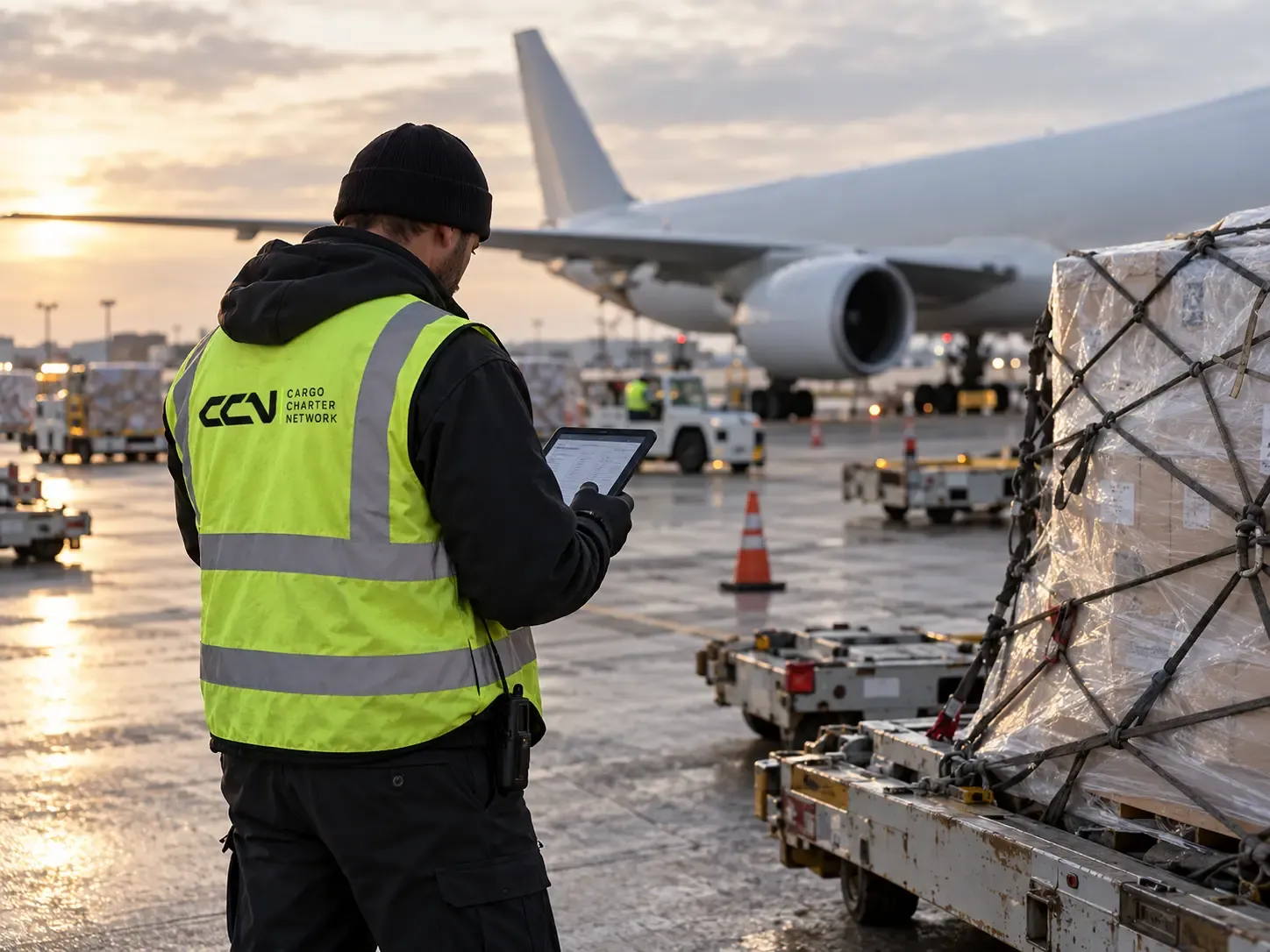
Hub supervisor tracking parcel containers on a tablet

Scope of service

E-Commerce

Dedicated rotations through Singles Day, Black Friday and the Christmas peak.

  • Cross-border parcel and marketplace volumes
  • Peak-season dedicated rotations
  • Fulfilment-centre restocking flights
  • Returns and reverse-flow consolidation

Why marketplaces charter

Peak coverage

Dedicated rotations through Singles Day, Black Friday and the Christmas peak.

Marketplace volumes

Full aircraft for cross-border fulfilment between hubs.

Customs flow

Bulk clearance and hub handover planned with the flight, not after it.

Direct to operator

One brokerage layer, not three.

In air cargo charter it is common for a requirement to travel through several intermediaries before it reaches the aircraft operator. Each layer adds its own commission to the same flight. We work directly with operators, so the quote you see carries one commercial layer.

Typical chain

  1. 01Shipper or forwarder issues the requirement
  2. 02Broker A takes the enquiry, adds margin
  3. 03Broker B or C is asked for capacity, adds margin
  4. 04Operator finally quotes the flight

With Cargo Charter Network

  1. 01You submit the requirement once
  2. 02We approach operators directly from our network
  3. 03You receive comparable options with one accountable contact

No stacked commissions

The requirement is not passed sideways to other brokers who each need to earn on the same lift.

No cost on top for you

We are remunerated by the operator. Our involvement does not add a separate fee to your charter price.

Faster and cleaner information

Payload, dimensions, ready date and airport constraints reach the operator unchanged, instead of being relayed through several desks.

Real comparison, not one option

Because we source across operators ourselves, you see the realistic market for that routing rather than whatever one intermediary could reach.

Availability, pricing and acceptance always remain with the operating carrier. Where a requirement can only be served through a partner, we say so before you decide.

How we work

Broker, not operator

Cargo Charter Network does not operate aircraft and employs no flight crew. Every flight is performed by a licensed operator we source, compare and coordinate.

Operator selection

Operators are checked for AOC validity, insurance, aircraft configuration and route authority for the specific mission before a price is put in front of you.

One accountable contact

The same person handles sourcing, contract, permits, handling and flight watch, so there is no handover gap between quote and arrival.

What we will not do

We do not quote capacity that has not been checked with an operator, and we do not confirm acceptance of restricted commodities before the operator has accepted them in writing.

What we need to quote

  • 01Origin fulfilment hub and destination sortation hub
  • 02Daily or per-flight parcel count and average parcel weight
  • 03Build-up form: bags, loose load or containers
  • 04Battery content and restricted items in the parcel stream
  • 05Customs procedure and broker at destination
  • 06Required frequency and campaign period

Operational detail

Sortation window

The value of the flight is decided by whether the load enters the sorter on time. Offload and hub handover are planned against that window, not against block time.

Restricted items

Parcel streams hide batteries, aerosols and magnets. A written screening statement protects the flight from a refusal at build-up.

Committed versus spot

Committed rotations booked before peak season price materially below spot capacity in the same weeks.

Typical requirements

  • South China → Central Europe, nightly parcel rotation through peak weeks
  • Europe → Middle East, marketplace restocking on a narrow-body freighter
  • Asia → UK, consolidated returns flow added to an existing rotation

Anonymised examples of requirements evaluated by the desk. Not a record of completed flights.

Parcel capacity enquiry

Share the parcel volume and the sort window

Frequency and the destination sortation time shape the rotation more than the flight distance.

Peak rotations, marketplace restocking and returns flows between fulfilment hubs.

Subject

E-commerce charter enquiry

Airport compatibility known at origin/destination

Your details go straight to the charter desk. No account is needed to enquire — you can create one afterwards to track the status. Rather talk to us directly?

How to submit a requirement

How a requirement is handled.

You send the requirement straight to the desk — no account needed. We work it against operators immediately and come back with compared options.

  1. 01

    Send the requirement

    Route, ready date, weight, dimensions, commodity and handling notes — no account, a few minutes.

  2. 02

    We check

    Availability, payload and route permissions are checked directly with operators.

  3. 03

    Receive options

    Compared operator options with payload, slots, handling and timeline — one accountable contact.

  4. 04

    Account (optional)

    For status tracking and document exchange in the portal. Account verification is usually the same business day.

No supplier identities, margins or internal sourcing data are shared. Requirement data is treated confidentially.

Freighter offloading parcel containers before a night sort

Aircraft

  • 01B737-800BCF and A321P2F for regional replenishment
  • 02B757-200PF and B767-300F for mid-size volumes
  • 03A330-200F, B777F and B747-400F for main-deck peaks
  • 04IL-76TD and An-124 where ramp loading is required

Availability is subject to route, payload, permits and operator acceptance.

Capacity structures

Four ways to buy the capacity

The same requirement can be bought as a whole aircraft, as a share of one, as reserved space on a running rotation or as leased capacity with crew. The structure decides the price far more than the aircraft type does.

Show details

01

Full charter

One shipment fills a deck, or timing and commodity rule out sharing

You control the schedule, the loading plan and the routing.

02

Part charter

Volume fills part of a deck and the ready date tolerates consolidation

Cost is shared across shippers inside one build-up window.

03

Blocked space

Recurring volume on a lane that already has a rotation

A fixed allocation per flight, committed for a defined period.

04

ACMI / wet lease

Capacity is needed for weeks or months, not for one flight

Aircraft, crew, maintenance and insurance leased against guaranteed block hours.

Fuel, ATC, airport charges, handling and de-icing sit outside an ACMI rate. On charter they are inside the quoted price unless stated otherwise.

Around the flight

What we coordinate besides the aircraft

A charter is only as good as the ground scope attached to it. These items are quoted and coordinated as part of the mission, not left to the shipper.

Show details

Customs and documentation

Export and import entries, transit procedures, temporary export for repair, preferential origin papers and the broker interface at both ends.

ULD build-up and packing advice

Pallet and container build-up, load spreading, lashing plans and guidance where packaging would fail an operator acceptance check.

Trucking and last mile

Pre-carriage, on-carriage, air-ride equipment where needed, low-loaders and permitted road routes for outsize crates.

Permits and slots

Overflight, landing and cabotage permits, airport slots, night curfew handling and diplomatic clearances where they apply.

Temperature and monitoring

Cool storage, active or passive units, cool dollies, data loggers and shock or tilt indicators read at each handover.

Supervision and escorts

Loading supervision, attendants for live cargo, security escorts and sealed handovers for high-value consignments.

Parcel rotations

Rotations built around sort windows

Parcel charters are planned from the destination sorter backwards, which usually forces night departures and tight offload slots.

01

Shenzhen (SZX) → Leipzig (LEJ), nightly parcel rotation

Ready date behaviour
Bags closed at the fulfilment hub four hours before departure
Airport compatibility
LEJ offload slot aligned with the night sort
Aircraft usually shortlisted
B747-400F, B777F
02

Liège (LGG) → Riyadh (RUH), marketplace restocking

Ready date behaviour
Container build finished before the evening cut-off
Airport compatibility
RUH bulk customs procedure agreed with the broker
Aircraft usually shortlisted
B737-800BCF, B757-200PF
03

Hong Kong (HKG) → East Midlands (EMA), returns backhaul

Ready date behaviour
Reverse flow consolidated on the existing outbound rotation
Airport compatibility
EMA container handover checked against sorter capacity
Aircraft usually shortlisted
B777F, B767-300F

Regions handled most often

  • South China ↔ Central Europe
  • Europe ↔ Middle East
  • Asia ↔ United Kingdom
  • Europe ↔ North America

A rotation that lands after the sorter closes has no operational value, so the offload slot is agreed before the schedule is fixed.

Parcel freight background

Parcel density and the loading plan

Parcel freight is low density and highly volumetric. Bag or loose-load build-up, container mix and the sortation interface at destination decide how much of the aircraft is genuinely usable.

We plan build-up and offload against the hub sortation window so parcels enter the sorter rather than queue on the ramp.

Show details

Peak planning beats spot buying

Peak season capacity disappears before the promotional calendar is even published. A committed rotation booked in advance is materially cheaper than spot charter in November.

For lanes with unstable volume, a mix of committed rotations and part-charter flex keeps the cost per parcel under control.

Questions

Frequently asked questions

Answers from daily desk work: payload, ready date, permits and cost drivers.

See all questions

Yes, once daily volumes fill a narrow-body deck. Below that, part charter or block space on an existing rotation usually fits better.

Talk to the desk

Urgent? Call the desk directly.

AOG and time-critical requirements can be raised by phone or email at any time — no account required.

Availability
24/7 for AOG and time-critical
First response
Usually within 60 minutes
Freighter aircraft being loaded on the apron before departure

Move the next mission

Send the requirement and the desk will come back with sourced options, or call now if it is time-critical.